
Key takeaways:
- Physical activity prescriptions should be individualized and emphasize that any activity is better than none.
- Framing movement around health, function and enjoyment vs. simply weight loss can improve adherence.
Weight bias and stigma have been increasingly recognized as a major barrier to effective obesity care and the mental well-being of patients.
Burn more calories, move more to lose more weight. It seems logical. But the evidence has made it increasingly clear that this is a fundamentally incomplete way to think about physical activity.
My perspective regarding this topic shifted over years of practice, and it has shifted even further as I have spent more time in obesity medicine. I now think of physical activity less like a weight loss tool and more like a vital organ — something essential to every system in the body, something that does its job regardless of what the scale says. I have also come to understand how much the conversation itself matters: the words we use, the assumptions we make and whether patients leave the exam room feeling seen or judged.
Here is how I approach physical activity across the lifespan in patients with obesity, drawing on both the evidence and my day-to-day clinical experience.
Moving beyond the scale
Exercise training produces, on average, about 2 to 3 kg of additional weight loss. That is it. If we tell patients that movement is primarily a weight loss intervention, we are setting them up for disappointment and dropout. The real story is that physical activity improves cardiorespiratory fitness, reduces visceral adiposity, enhances insulin sensitivity, lowers blood pressure and triglycerides, builds muscle strength, and meaningfully improves quality of life — all largely independent of what the scale does. There is now compelling evidence that cardiorespiratory fitness may be a more important predictor of survival than weight or body fat itself.
That reframe matters enormously in the exam room. When a patient tells me they have been walking every day but “it’s not working” because the number on the scale has not moved, I want to have a different conversation than the one they have been having with themselves. The American Association of Clinical Endocrinology (AACE) 2025 consensus statement makes this explicit — physical activity is therapeutic across all stages of obesity care, including during active weight loss to preserve lean mass and metabolic rate, and during maintenance, where 150 to 300 minutes per week of moderate-intensity aerobic exercise is the target.
I come back to two simple ideas here: “motion is lotion” and our goal should be “making the immobile mobile again.”
How we have the conversation matters as much as what we say
Weight stigma is real, it is pervasive in health care settings, and internalized weight bias is one of the strongest predictors of anxiety, depression, body dissatisfaction and reduced motivation for healthy behaviors. I think about this particularly with my patients who have spent years hearing variations of “you just need to move more” — often delivered without acknowledgment of the structural, physiological and psychological complexity of what they are managing.
The 5As framework — Ask, Assess, Advise, Agree, Assist — can be a very useful tool. Ask permission before launching into a physical activity discussion. Assess where the patient is motivationally, not where you assume they should be. The research supports this: each additional counseling step is associated with meaningfully increased patient motivation. For patients who are not yet thinking about change, the conversation is not about prescribing a regimen — it is about exploring barriers and misconceptions. Using person-first language, asking patients which terms feel right to them, and framing movement around enjoyment and function rather than weight loss are all essential clinical tools.
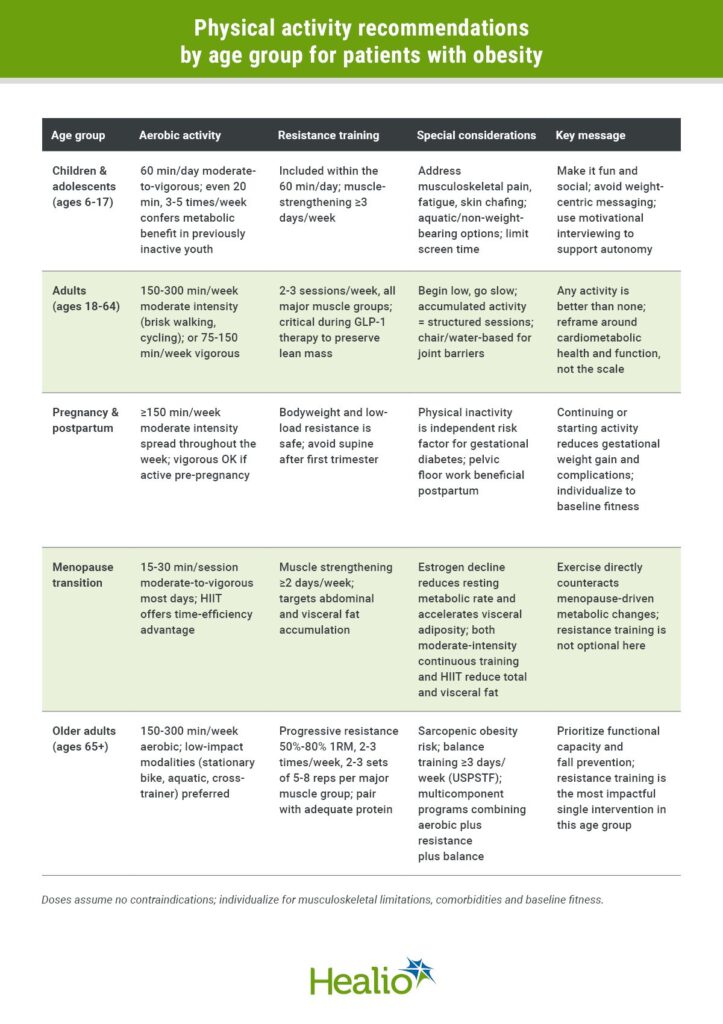
Children and adolescents: Start low, make it fun, watch the messaging
The American Academy of Pediatrics 2023 guidelines recommend 60 minutes of moderate-to-vigorous physical activity daily for children and adolescents with obesity — consistent with the Physical Activity Guidelines for Americans. What I would add from a practical standpoint is that even 20 minutes a day, 3 to 5 days per week, can meaningfully improve metabolic parameters in kids who were previously sedentary. The threshold is not perfection.
Children with obesity often face barriers that do not get enough clinical attention: musculoskeletal pain, fatigue, skin chafing, motor skill gaps and the very real social weight of exercising in environments where they feel exposed. Aquatic exercise, non-weight-bearing options and physiotherapy referrals when needed are all legitimate parts of the picture. And for adolescents especially — a population already navigating body image and identity — motivational interviewing that supports autonomy and reduces the perception of clinician judgment is key. Weight-centric messaging in this age group does real harm.
Adults: Start where the patient is, not where the guidelines are
The AACE 2025 guidance offers two principles I think should be on the wall of every exam room: “begin low and go slow,” and “any activity is better than none.” I love the second statement and quote it often! These are not concessions to low expectations — they are honest acknowledgments of where most patients are starting from, and what actually produces sustainable behavior change.
A short walk during a lunch break, standing more frequently, 2 minutes of movement every hour — these are real entry points. Accumulated activity throughout the day is as beneficial as structured sessions for body weight regulation. We cannot underestimate the power of NEAT (non-exercise activity thermogenesis).
For patients with musculoskeletal barriers — and the prevalence of low back pain increases incrementally with BMI, from about 3% at normal weight to nearly 12% at BMI of 36 kg/m2 or more — chair-based exercises, water-based exercise and physical therapy referrals are all options for patients who are limited due to these barriers.
Resistance training is consistently underemphasized, and this is particularly important right now. With GLP-1 receptor agonists producing substantial weight loss, roughly 40% of that weight loss can come from lean mass. That is a number worth noting — and highlights the importance of having a conversation regarding exercise, prior to prescribing medications.
Life transitions: Pregnancy, menopause and aging
ACOG recommends at least 150 minutes per week of moderate-intensity aerobic activity during pregnancy and postpartum. Physical inactivity and excessive gestational weight gain are independent risk factors for gestational diabetes and maternal complications — and women who were active before pregnancy can continue vigorous activity.
Menopause brings a distinct challenge: abdominal fat accumulation, decreased resting metabolic rate and increased cardiovascular risk driven by estrogen decline. Regular aerobic exercise and twice-weekly muscle-strengthening activities directly counteract these changes. Both moderate-intensity continuous exercise and high-intensity interval training (HIIT) reduce total and visceral fat in postmenopausal women — HIIT offers a time-efficiency advantage worth noting for patients who struggle to carve out 30 to 60 continuous minutes.
In older adults, the stakes compound further with sarcopenic obesity — the loss of lean mass in the context of excess adiposity, which is metabolically and functionally dangerous. Multicomponent programs combining aerobic, resistance and balance training are the standard. Progressive resistance training at 50% to 80% of one repetition maximum (RM) two to three times per week is safe and effective, even in frail individuals. The USPSTF recommends balance training at least 3 days per week for older adults at fall risk.
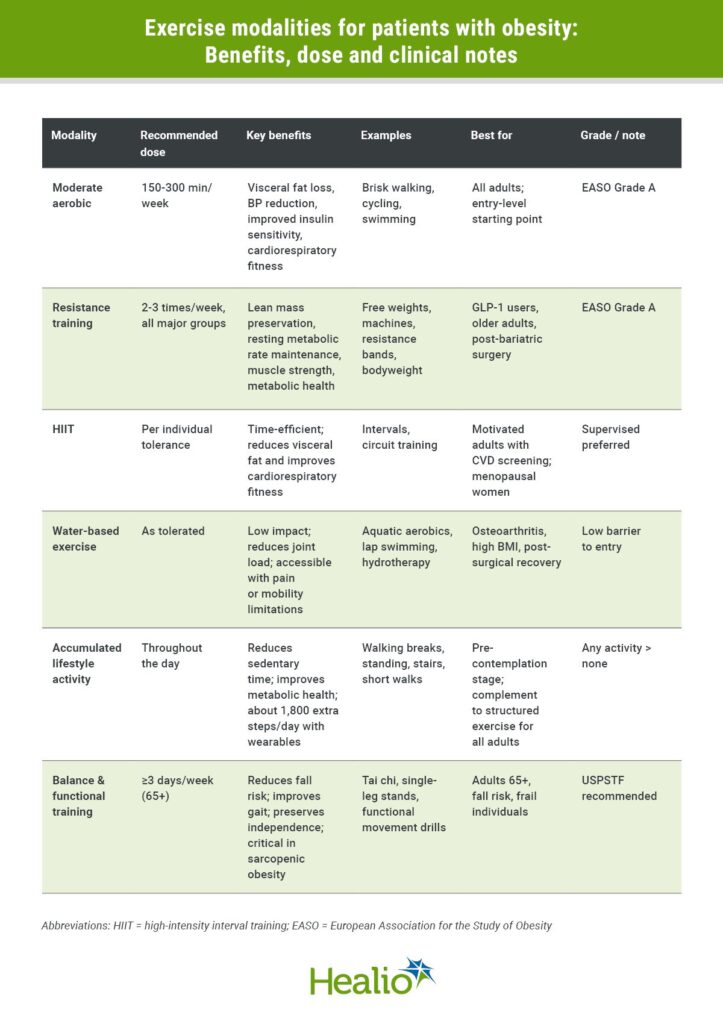
Misconceptions worth naming directly
A few narratives circulate among patients — and sometimes among clinicians — that are worth explicitly countering.
Exercise alone will not produce major weight loss. That is not a failure of the intervention; it is an honest description of the evidence. What exercise does produce — cardiovascular risk reduction, improved insulin sensitivity, preserved lean mass, better mood, better sleep — is clinically meaningful regardless.
Meeting guideline targets is not a prerequisite for benefit. Sub-guideline activity confers real health improvements. The goal is progress, not compliance.
Exercise is not unsafe for patients with severe obesity. With appropriate screening and individualized prescription, physical activity is both safe and beneficial. The health risks of inactivity far exceed the risks of exercise-related adverse events.
And adherence barriers — pain, fatigue, obstructive sleep apnea-related daytime sleepiness, the psychological weight of exercising in stigmatizing environments — are not willpower failures. They are clinical problems that require clinical solutions.
Prescribing physical activity: The FITTE framework
Physical activity should be prescribed like medication — with individualized parameters and regular follow-up. The American Heart Association recommends routine assessment of physical activity as a vital sign at every clinical encounter. The FITTE (frequency, intensity, time, type and enjoyment) framework provides a practical structure for individualized prescribing.
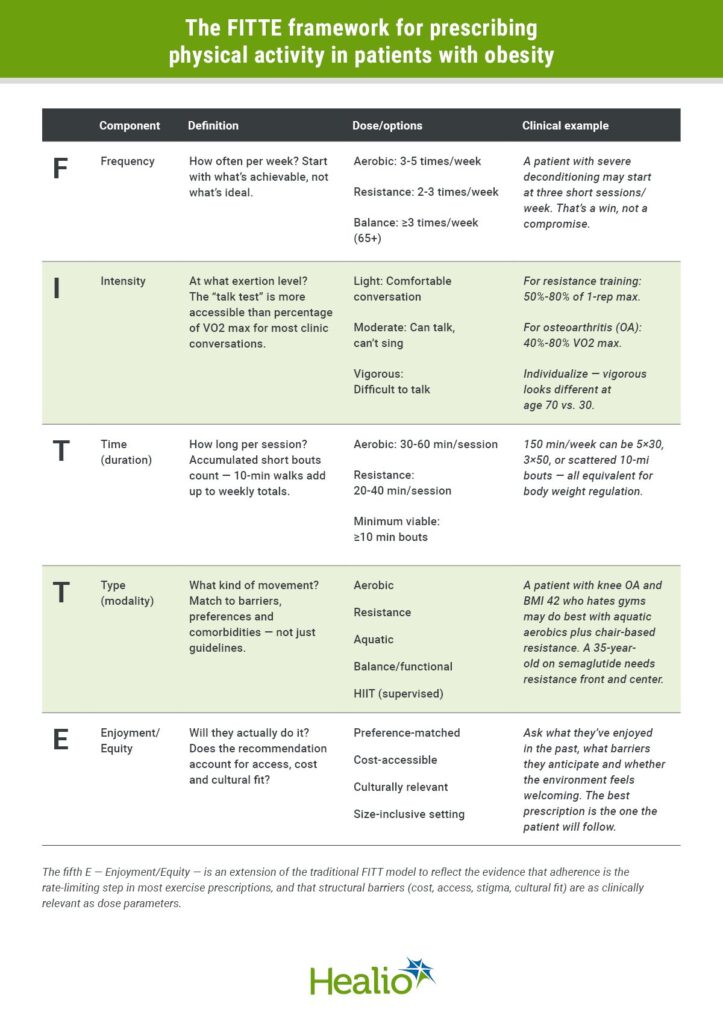
I usually end every exercise conversation with patients by coming back to the “E”: enjoyment. If patients enjoy what they are doing, they are far more likely to keep doing it — and that is what makes lasting lifestyle change possible.
A final note on framing success
In my obesity medicine practice, I have moved toward celebrating what I call non-scale victories: better energy, improved sleep, a reduced medication burden, the ability to walk to the mailbox without pain. These are not consolation prizes. They are the actual outcomes we are after, and they deserve the same clinical acknowledgment as any lab value or any number on a scale.
To understand why, it helps to hold two frameworks in mind simultaneously — one from obesity medicine, one from lifestyle medicine — because together they capture the full picture of what we are actually trying to accomplish.
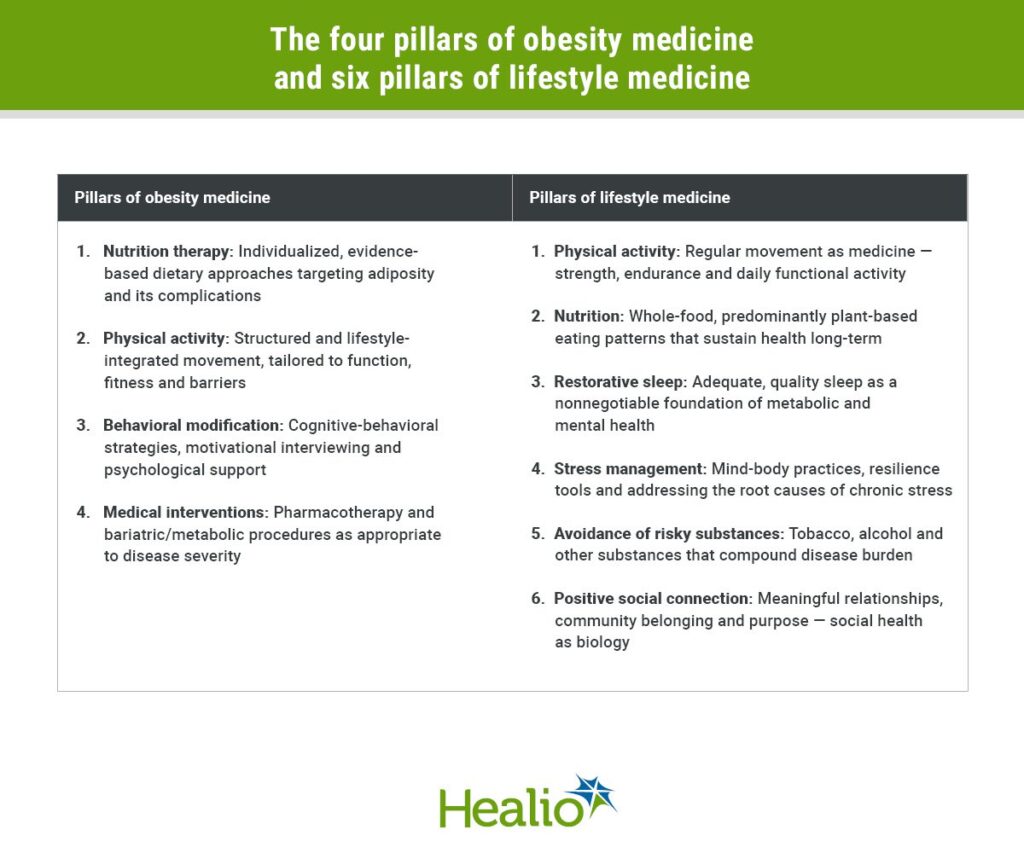
Here is what I find myself coming back to at the end of every clinic day. A patient who shows up at 6 months and has not lost a single pound — but who is sleeping better, managing stress differently, has stopped smoking, is moving their body three times a week and genuinely enjoying it, and has a reason to get up in the morning — is healthier in every way that matters. They are touching all six pillars of lifestyle medicine. They are engaged in the core work of obesity medicine. And the BMI has not moved.
We have spent decades organizing our clinical intuition around a number that was never designed to measure health. BMI tells us something about population risk. It tells us almost nothing about the person sitting in the exam room in front of us. A patient who has made physical activity a genuine habit — who has woven it into their routine, who missed it last week and actually noticed — has accomplished something profound. This, in my opinion, is the true goal.
Physical activity, prescribed thoughtfully, communicated without judgment and adapted to where each patient actually is — across their age, their life stage, their barriers — is one of the most powerful interventions in our toolkit. Not because of what it does to the scale, but because of everything it does that the scale will never measure. It is time we started treating it that way.
OMA resources worth your time
If you want to explore these topics further, the Obesity Medicine Association offers several practical, evidence-based resources. Three are especially worth your time.
The OMA Obesity Algorithm is the clearest clinical framework for obesity care, covering screening, diagnosis, staging and all four treatment pillars. For American Board of Obesity Medicine (ABOM) exam preparation, it is the key review resource; for practicing clinicians, it remains one of the best concise guides to obesity as a chronic disease.
The OMA blog posts on obesity and exercise and pediatric obesity physical activity update posts build on this article by reviewing exercise modalities, addressing common misconceptions and offering practical counseling strategies for patients discouraged by limited scale changes.
Finally, the OMA blog post on obesity and mental health deserves close attention because weight stigma directly affects motivation, treatment engagement, mental health and long-term outcomes. Internalized weight bias is a major barrier in care, and understanding it is essential to addressing it effectively.